

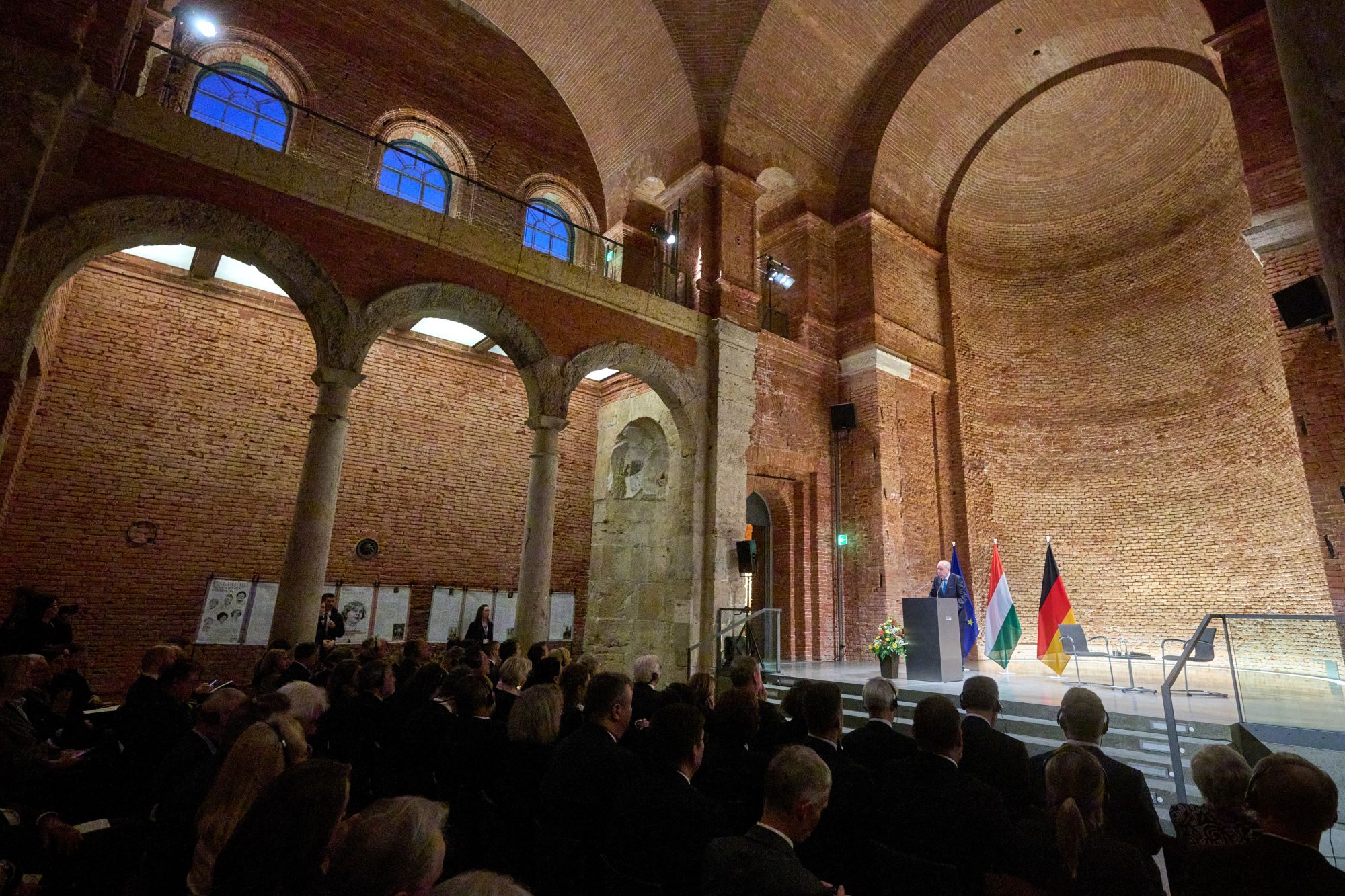
Speech delivered in Munich by Dr. Tamás Sulyok, President of Hungary, on Memorial Day for Deportation of Ethnic Germans from Hungary
There have been a few turbulent centuries in the history of Europe, but I think we can all agree that the 20th century was one of the most terrible of them all. It is often said that time heals all wounds.
I can agree with this statement only if the passage of time does not mean forgetting, but rather an enduring commitment to learning from what has happened and to stand stronger together because of it. We share a solemn responsibility: to confront the
lessons of the past together, to honour the memory of the victims together, and to strengthen our communities together, so that these horrors cannot happen again.
And we must not forget — and we cannot. A nation that forgets has learned nothing.
The principle of collective guilt has no place in Europe! No theoretical, ideological or legal argument can be accepted that pillories communities, discriminates against them or punishes them with measures of a legal nature. We must commit ourselves to ensuring that no one in Europe can ever again be deprived of their constitutional rights, and that there can never again be circumstances in which indigenous nationalities have cause for fear.
The era of the lies of collective discrimination is over; it has no place in 21st-century Europe.
Not in politics, not in society, and not in the field of law. Today, the following principle must be fundamental: it is completely unacceptable for anyone in Europe to be stigmatised on the basis of their community.
Ladies and gentlemen!
My dear German Friends!
One of the deepest pains in our shared German–Hungarian history, reaching back centuries, is the expulsion of Germans from Hungary.
By my presence at today’s commemoration, I wish to make clear that this was not only a blow to the German nation. It is a tragedy we share. It is just as painful for the Hungarian nation, and just as deep a wound for Hungary itself.
We will never forget those who were deported, or their descendants. Hungary welcomes those who choose to return home!
Eighty years ago, my compatriots were expelled because they were of German nationality. They had to leave everything behind: their homes, their land, and their farms.
Their relatives, friends, neighbours – those with whom they belonged to a community. Yet the German nationality had been an integral part of Hungary for centuries. The mark of the German people, the fruits of their labour and their cultural influence are present in Hungary, in Hungarian culture, and cannot be erased.
Today's Memorial Day also teaches us that we must constantly stand up for indigenous national minorities. There can be no time when we neglect to protect their interests.
In Hungary, we have taken numerous measures to enable national minorities to preserve their identity and culture, maintain their language, cultivate their traditions and prosper. My German compatriots are particularly active in community organisation and identity preservation. They set a shining example for all communities. Thanks to their effective representation of their interests, they are members of the Hungarian National Assembly in their own right, through their nationality advocate. I would like to express my gratitude and appreciation for their community-building activities!
Ladies and gentlemen!
We Hungarians and Germans are bound together by a thousand years of history, and this bond is unbreakable. Our cultural and lifestyle interactions and our political and economic relations are extremely significant.
Of course, there have been times when some of the threads of our relationship have loosened, but at such times, another thread has held us together and bound us more tightly. We have had plenty of time to learn that there is no loose thread that cannot be strengthened through common will and effort.
And, of course, we have also learned that there is no bond so strong that it cannot be broken. This means that even relationships that are obviously good need to be protected and nurtured. It follows from this that it has always been the farsighted in both nations who strengthened relations and maintained friendship in all circumstances. Those were on the right path who, despite differences of opinion, worked for cooperation — guided by mutual respect and mindful of one another’s interests.
Personally, I stand with this direction. I consider myself part of the community of those who regard German–Hungarian relations as a shared value and who work with the intention of strengthening our unity. I am convinced that those who build upon the
foundations that lie deep beneath the surface — the enduring bonds of history, culture, and mutual respect — are the ones who act wisely and responsibly.
We are witnessing a global realignment: we can see that multilateral institutions are struggling to function. In this environment, the importance of bilateral relations is growing particularly significantly.
Hungary is prepared for this, as we have never had such an extensive diplomatic network around the world as we do today, and we are constantly working to strengthen our relations and develop further partnerships. Among these, deepening our relationship with Germany is particularly important to us. I would like to express my gratitude and appreciation to all those individuals, our ambassador, our diplomats and our various social organisations who nurture the relationship between our countries in their daily work!
Dear Mr President!
Dear friends in Germany!
I bow my head in memory of my German fellow citizens who were expelled from my homeland! I share the pain they had to endure in those difficult times!
Many thanks to all those who have helped the people driven from my homeland! I thank this community for preserving the memory of the victims!
Many thanks to all those who bring German-Hungarian relations to life, who work and strive to maintain and further deepen friendship and cooperation between us!
And beyond that, I would also like to thank you for your kind attention.
(Munich, 19 January 2026)