

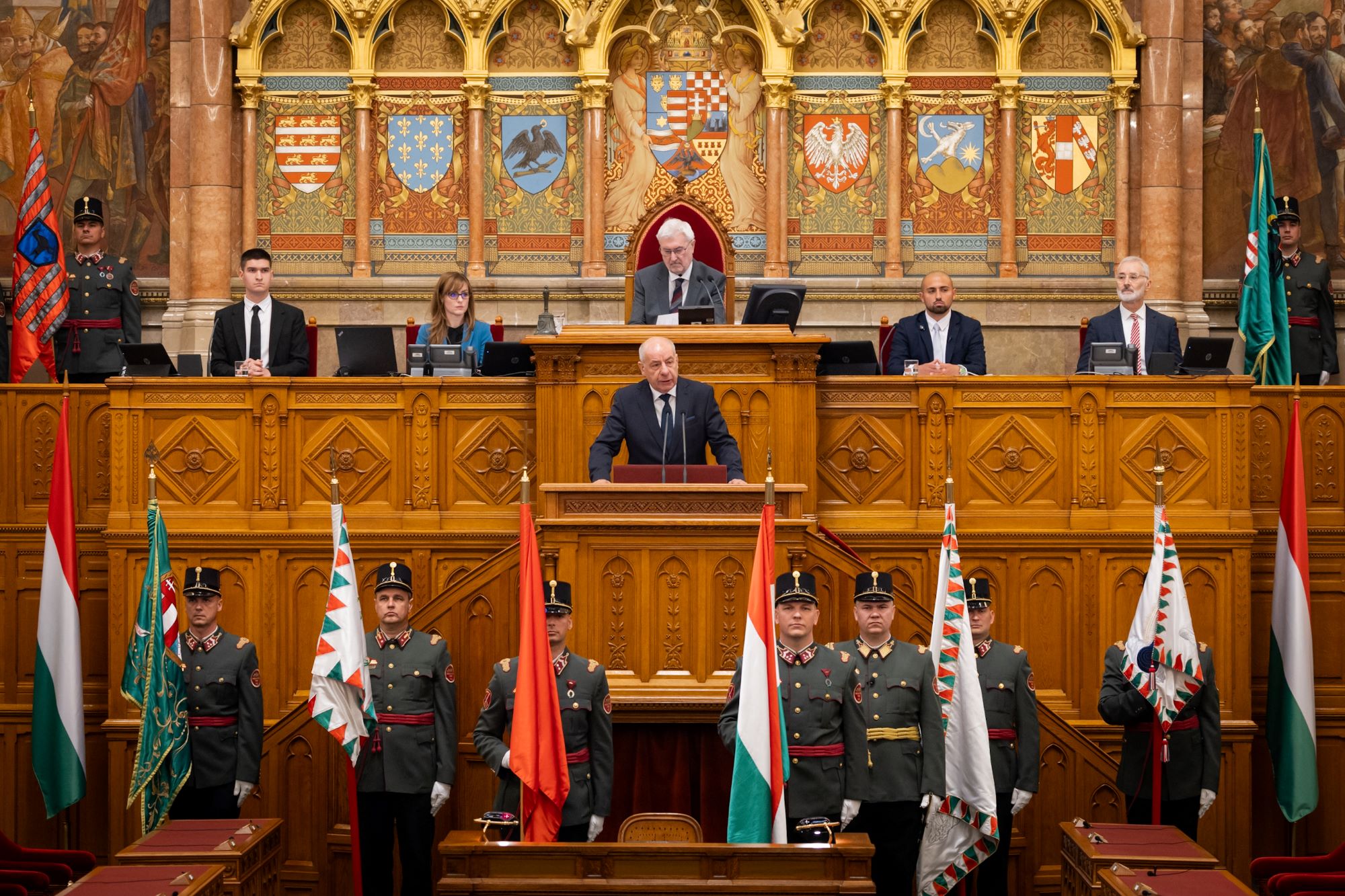
Speech by Dr. Tamás Sulyok, President of Hungary, on the occasion of the inaugural session of the new National Assembly
Honourable Members of the National Assembly!
Dear Compatriots!
For a thousand years, we have lived as a nation with its own state. For a thousand years, our nation has been determined - and capable - of shaping its own life. As far as any community can, we have done everything in our power to take our fate into our own hands. We have done so both in times of good fortune and in times of hardship; sometimes with success, sometimes with setbacks. Yet we have never relinquished our right to make our own decisions.
Now, we have entered a new chapter in Hungary’s history. The composition of the National Assembly, convened for the tenth time since the change of regime, will result in a change of government after four parliamentary terms.
In the April parliamentary elections, the Hungarian people expressed their will in accordance with our country’s democratic legal system. With unprecedented voter turnout and an unprecedented victory, the Respect and Freedom Party has been entrusted by the Hungarian people with the task of governing the country, for which I would like to take this opportunity and extend my congratulations. With this mandate, the Respect and Freedom Party also bears a historic responsibility toward our country and toward our nation.
A responsibility and a service whose stakes are nothing less than the progress of the country and of the communities of our nation, the strengthening of the nation’s capacity, and ensuring its resilience in the face of danger.
Honourable Members of Parliament!
You are the parliamentary representatives of a nation which has upheld its identity, legal system and culture for centuries, and which has always been capable of renewal - even in times of difficulty. That heritage is now in your hands.
From today on, your workplace is the building that stands as the foremost symbol and home of the entirety of our Hungarian nation, its sovereign statehood, and its representative democracy. It is a special venue; for foreigners it forms part of the universal World Heritage, but to us Hungarians, it means far more than that. The Parliament Building is a bastion of our self-respect, our national freedom, and the rule of law — filled with symbols of our statehood, our history, and our legal system. Every corner of this building is interwoven with the nation’s memory and its hopes for the future.
This building, still standing today in all its splendour as the House of the Nation and a source of pride for the Hungarian people, now opens its doors to you so that, through your work, you may protect the country and lead it forward.
Yet these stately walls also bear witness to a multitude of the harshest trials and to extraordinary acts of endurance. Many great figures and officials of the National Assembly strove to stand their ground even in the most turbulent times. I will mention just one: in 1956, when the country was enduring the darkest hours of the Soviet occupation, hardly anyone remained in the building.
However, a lawyer-turned-minister, István Bibó — who upheld the primacy of the democratic state and the inescapable rule of law — chose not to leave. Risking his life, he remained at his post and stood firm in his belief in the democratic legal order. István Bibó held the same conviction as the late heads of state Ferenc Mádl and László Sólyom — and as I myself do — namely, that the law must have an added value. The law must be directed toward the good, toward order, justice, and humanity. The fundamental principle of lawyers and lawmakers is that “it is not man who exists for the law, but the law that exists for man.”
This principle is what enables the law to hold a country together and provides the foundation for a legal framework that stands above the exercise of power.
The millennial history of our legal system traces its origins to Saint Stephen, the first king of our state and the country’s first lawgiver. Your legislative mandate is also part of this continuity.
Our conception of law is inseparable from our European identity, which likewise traces its origins to Saint Stephen. It was through his conscious choice that we definitively became part of Europe—not only in a geographical sense, but also in a spiritual and cultural one. From that moment on, the Hungarian people have also been European. But the reverse is equally true: Europe is inconceivable without Hungary. We, too, have broadened the continent’s values and enriched its culture. Our European identity stems from a freely made choice – one that successive generations have continually reaffirmed to this very day.
Respect for the law in Hungary cannot be open to question. All power can only be interpreted within the framework of the rule of law.
Any political action can be considered democratic only as long as it remains within the framework of the constitutional order based on the rule of law. The supremacy of a legal order that seeks the good of the people, safeguards their freedom, and guarantees order and predictability must serve as a guiding principle for those exercising power at any given time. Legal certainty is a value that we must preserve under all circumstances. Undermining the rule of law would have unforeseeable consequences for people’s lives and their trust in the legal order.
It is of paramount importance for our country that, here in the seat of our legislature, the constitutional foundations of the Hungarian nation and the checks and balances embedded in our legal system be treated with the utmost respect.
The most appropriate place to address our common concerns is the Parliament Building; the most effective way is mutual respect; and the best instrument is the clear and restrained language of legal norms.
Honourable House!
Honourable Members of Parliament!
Serving the country and representing the Hungarian people is the greatest honour and the noblest responsibility. It is in this spirit that the four years of work ahead of you must be viewed. You have joined the ranks of the nation-builders of the past millennium. Therefore, everyone who has the privilege of representing the nation in the Hungarian Parliament has a historical role to fulfil, and none other than history itself will judge your work. Likewise, it is in this context that your oath — taken before the National Assembly — must be interpreted. Although your mandate lasts for four years, your service extends beyond parliamentary cycles and thus beyond the debates of daily politics.
After a fiercely contested campaign, politics must return to its natural setting: the framework of public law. The focus must once again be solely on improving the country’s future. There is room for improvement in our relations with one another. After all, the way we behave toward one another, the way we speak to one another, and the way we look at one another in fact reflect our attitude toward our homeland. Hungary can only be built if we build it together, and not against one another. For my part, I propose constructive cooperation on every issue that advances our country’s future, strengthens our nation, and fosters peace and calm in public life.
I saw a fine example of this constructive cooperation during the preparations for the inaugural session of the National Assembly. For this, I extend my thanks to the representatives of the parties, the Director General of the National Assembly, the Director General of Sándor Palace, and their staff.
Honourable National Assembly!
A country, a nation, can only be strong if it is united in its diversity, and if it respects and upholds everyone’s dignity. You, as Members of Parliament, have a special role to play in this unity.
Not only through your decisions, but also through your personal example. You have been mandated to represent the whole nation: those who agree with you, and also those who do not; the strong, and those who need protection. You have been entrusted with responsibility for every citizen of this country — regardless of their worldview, place of residence, or life situation.
I warmly congratulate you on your parliamentary mandate!
Let me also extend my cordial congratulations to our Nationality Representatives. Hungary’s national minorities are inseparable from our country, and true national unity can only be achieved with their participation. Protecting their rights are supporting their communities is a matter of course.
I wish that your work will always be guided by a sense of responsibility toward the nation, mutual respect, and an unwavering commitment to the rule of law.
I also sincerely wish each of you every success, much strength, and a worthy service to the homeland and the nation!
Honourable National Assembly!
Article 9 (3) j) of the Fundamental Law of Hungary provides that the President of Hungary shall propose a candidate for Prime Minister to the National Assembly. I have invited Mr. Péter Magyar, President of the Respect and Freedom Party, to form a new government, and he has accepted this invitation. Therefore — on the basis of the cited provision of the Fundamental Law — I propose that the National Assembly elect Mr. Péter Magyar as Prime Minister of Hungary.
Thank you for your attention.
(Budapest, 9th of May, 2026)