

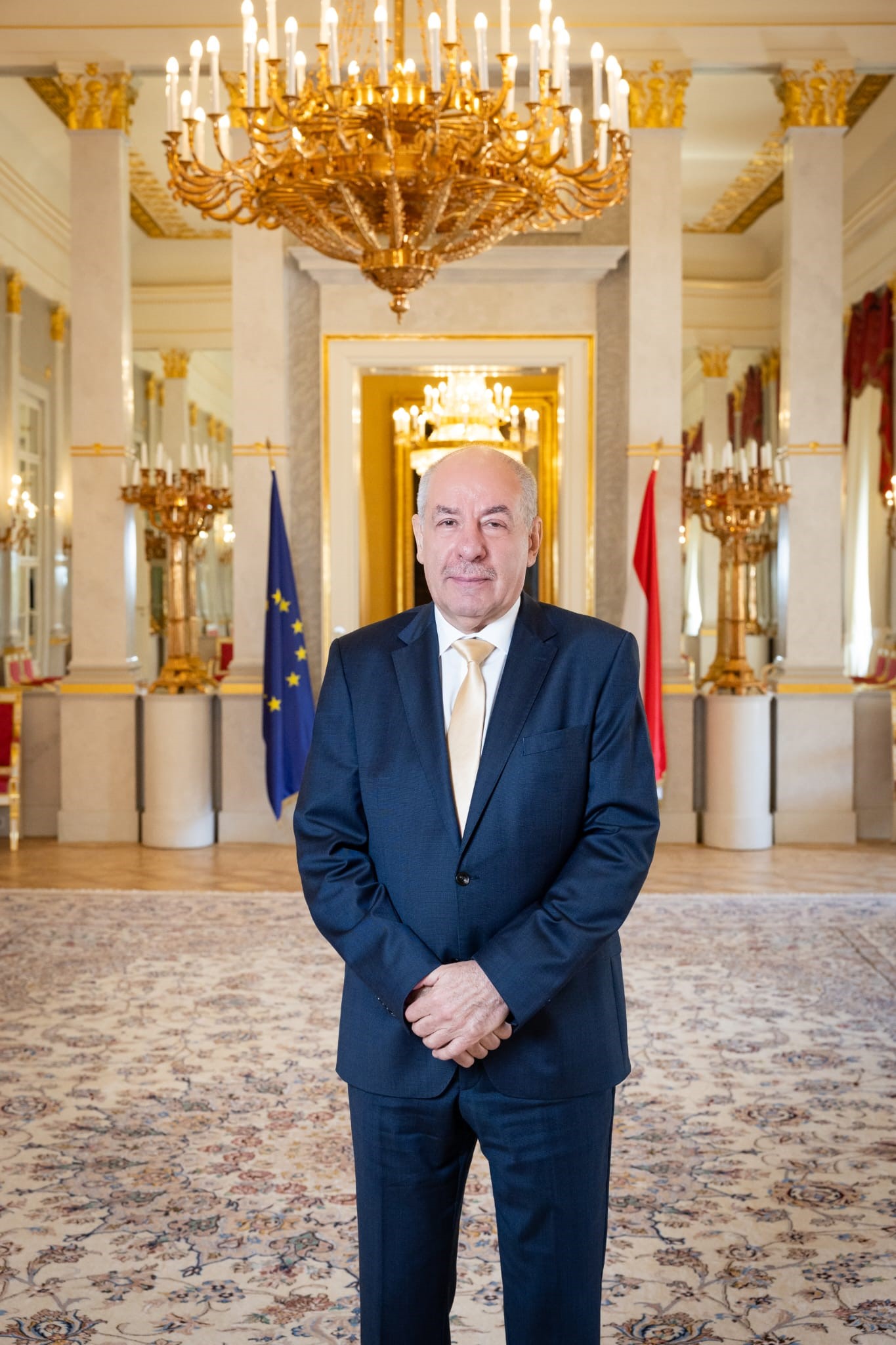
"Even the appearance of solutions that do not respect the rule of law must be avoided" - Interview with Tamás Sulyok, President of Hungary
Have you ever regretted a decision you made?
I cannot recall any decision that I have regretted. At most, such things may have occurred in minor, everyday matters. The past becomes part of life. I generally focus more on the present than the past, and I am shaping the future through my plans.
In one of your first interviews as head of state, you said you didn’t hesitate for long when you were asked to become President of Hungary. Have you not regretted your decision?
I haven’t regretted it. I believe that for a Hungarian, it is the greatest honour to be President of Hungary. The office involves a great deal of work; there are joys and there are difficulties, but together they form a single whole.
During the Orbán era, previous Presidents of Hungary, elected by a two-thirds majority, faced considerable criticism. Critics referred to them as Viktor Orbán’s “puppets”, “rubber stamps” and “party soldiers” – or they were described as “having no will of their own”. The pardon scandal dealt the final blow and shook confidence in the office of the head of state across the board. Today, we can be certain that the pardon scandal contributed to Fidesz–KDNP’s election defeat. When you were asked to take up the office, did it not occur to you that you would be heading a weakened presidential institution and would be faced with questions about your independence?
That wasn’t my main focus, though of course I was aware of those factors. At the time, I was President of the Constitutional Court, so I was already in public service. I thought that if I were asked to take up the office of President of Hungary, I couldn’t say no.
Let me put it another way: when you said yes, what was going through your mind? What did you hope to achieve as Head of State? Did you have any specific goals?
I emphasised this in my first statement after my nomination, and I reaffirmed it in my inauguration speech: as former President of the Constitutional Court, I accepted the nomination for President of Hungary with the intention of safeguarding constitutional stability by upholding the Fundamental Law and the fundamental values of the law. A government has its goals, a political party has its objectives; the head of state performs their constitutional duties and, by their very existence, embodies the unity of the nation. There are no political goals in this context. The head of state does not have, and according to the Hungarian constitution cannot have, a political programme.
For János Áder, environmental protection was one of the most prominent themes of his term in office, and Katalin Novák, upon taking office, placed family and family protection at the centre of her agenda, Did you have any similar objectives or priority themes?
I focused on working with communities, and sought ways to strengthen their nation-building power. It is my view that a nation is made truly successful by its well-functioning communities. I sought out people who have established and run such communities, with particular regard to those that help people in difficult situations or take on some kind of challenge. But every community can be a valuable asset, be it in sport or any other field. They are an asset for the nation.
What is your view of the criticisms listed above, which have frequently been levelled at Hungary’s heads of state during the sixteen years of Orbán’s governments?
The constitutional role and powers of the President of Hungary are unique, as the head of state has no direct political scope for action and therefore bears no political responsibility in the same sense as a government.
THE PRESIDENT OF HUNGARY REPRESENTS THE UNITY OF THE NATION BY PLACING POLITICAL DECISIONS WITHIN A CONSTITUTIONAL FRAMEWORK AND GIVING THEM CONSTITUTIONAL LEGITIMACY.
For example, when the Prime Minister nominates candidates for ministerial posts, the President appoints them. This means that a political decision acquires public law and constitutional status. From the outside, this may often appear merely ceremonial or unremarkable, but its constitutional significance is considerable, as it is through this process that the decision is validated by the unity of the nation.
Speaking of representing the unity of the nation, do you feel that you have succeeded in fulfilling this role so far?
Representing the unity of the nation is an extremely difficult responsibility. Particularly in pluralistic societies such as the ones we live in here in Europe. But this is as it should be, because in a pluralistic society, different views exist within the nation along various political, economic, cultural, and religious fault lines. In fact, it is the constitution and the law that establish unity within this diversity. The law applies equally to everyone, and its fundamental principle is that ignorance of the law does not excuse non-compliance.
So am I right in understanding that, in the case of the head of state, it is not primarily the individual that matters, but rather the institution’s role in expressing the unity of the nation within the constitutional framework?
Yes, that is one way of framing what I said.
Who asked you to be the ruling parties’ candidate for head of state? Who called you?
It was Viktor Orbán.
And what did he say to you?
He said that Fidesz supports my election as President of Hungary, and asked me to accept the nomination.
Did Viktor Orbán express any other opinions or positions, perhaps even mentioning the pardon scandal?
He did not express any position.
Did he not give you any advice?
He did not give me any advice.
After you were elected, did you remain in contact with Viktor Orbán?
For the constitutional system to function properly, it is natural that the President of Hungary must cooperate with the government of the day, as the presidential powers are linked to government activity in several respects. For example, when the head of state appoints certain individuals in accordance with the constitution, those appointments are generally connected to government processes. The same applies when the President represents the state abroad, as this is also clearly linked to the government’s foreign policy. For this reason, I regularly consulted Viktor Orbán, as Prime Minister of Hungary, on such matters, usually once a month.
As head of state, how do you keep abreast of public sentiment, and how do you gauge changes in it?
In this regard, I receive various reports from my colleagues, which I study.
Do you follow social media, read the news, or do you rely mainly on your advisers?
I am still a child of the Gutenberg Galaxy. I can navigate the digital world, but I don’t really feel at home there. As President of Hungary, I naturally have a Facebook page, which I monitor, but as a private individual I have never been active on social media.
How do you think the Hungarian people viewed the office of president when you were elected, and what do they think now, two years later, following the election on 12 April?
Whether or not someone has the support of the majority is a political question. The President of Hungary must represent both the majority and the minority – in other words, the unity of the nation as a whole. My constitutional role is to represent the unity of the nation. Effectively, I can perform this role within the legal and constitutional framework.
Following the election on 12 April, you hosted the leaders of the parties having entered Parliament at Sándor Palace. How would you describe the atmosphere at those meetings?
The atmosphere was open and businesslike. The main topic – given the circumstances – was the preparation for the inaugural session of the new National Assembly, as this must be organised by the Director-General of Sándor Palace and the Director-General of the Office of the National Assembly, in cooperation with the political group leaders of the parties that had entered Parliament.
How did your conversation with Viktor Orbán go?
I informed him that I would be proposing Péter Magyar as Prime Minister, which he naturally acknowledged, and I wished him well in his role in the opposition.
Did you expect this election result?
I was prepared for any election result, but from the perspective of my constitutional role, I considered the high turnout to be far more significant. I emphasised this on election night as well, when I gave a speech at 7 pm at the National Election Office building, even before the results were known. There, too, I spoke of how I regard the turnout as a victory for democracy, and that the winning political force will obviously have a strong democratic mandate.
According to the new ruling party, a regime change took place on 12 April. In your view, does the Tisza Party’s victory represent a simple change of government or is it more than that – a genuine regime change?
A change of regime took place in Hungary in 1990, when the country dismantled the one-party dictatorship. Since then, a democratic constitutional state has been operating in accordance with our constitution. Governments change – or remain in office – following parliamentary elections, depending on the outcome. This time, a change of government has taken place.
The first person you hosted at Sándor Palace was Péter Magyar, the leader of the Tisza Party, which won the election. How would you describe this meeting?
I can say the same about this meeting as about the others: the discussion was open and businesslike.
Constructive?
Yes, we discussed how to prepare for the inaugural session.
What was Péter Magyar’s attitude towards you during that meeting?
He behaved exactly as one would expect of a future prime minister.
Did he show the respect due to the office of the head of state?
Yes. Of course, he emphasised his position on why I should resign and set out his arguments. I simply replied that I saw the matter differently. I pointed out that our task at the moment was not to discuss this, but to prepare for the inaugural meeting.
Péter Magyar had already said before the election that they expected you to step down from the office of President of Hungary; he repeated this before your meeting on 12 April, and described you as unfit and unworthy to be the guardian of the rule of law in Hungary. What is your response to this?
The categories of ‘unfitness’ and ‘unworthiness’ are not contained in the Hungarian constitution. These are political value judgements, and as such, I do not wish to comment on them, because it is not my business to deal with political opinions. The Constitution does not recognise such categories.
At the inaugural session of the National Assembly, you spoke of how the foundation for democratic political action is respect for the constitutional order of the rule of law, upholding legal certainty, and a legal system that simultaneously guarantees people’s freedom, predictability and puts limits on power. Why did you feel the need to highlight these aspects in particular?
In a state that defines itself as a democratic state governed by the rule of law – and indeed, according to the Hungarian constitution, Hungary is a democratic state governed by the rule of law – these fundamental principles are of the utmost importance. An inaugural session of Parliament is a situation in which a new power structure begins to function following parliamentary elections; therefore, I considered it my constitutional duty to emphasise these principles.
If the election results had turned out differently, and Fidesz–KDNP had been able to form a government, would you still have delivered the same speech? Would you still have drawn attention to the framework of the rule of law in the same way? Were you not sending a message to Péter Magyar and the Tisza Party with your speech?
I had absolutely no intention of sending a message with my speech. Throughout my life, I have emphasised the importance of the rule of law in numerous speeches, including when I was President of the Constitutional Court. I do not think I have ever given a speech in which the issue of the rule of law did not come up in some form. As President of Hungary, I also spoke about this regularly, particularly on occasions when I addressed lawyers, or when the issue of the rule of law was of particular relevance.
But surely you realise that many people would have expected at least the same firm stance from you as Head of State even before the elections?
The election campaign is a period when, in particular, the President of Hungary should not speak out at all, or only in very extreme situations. This is true in general as well. As former President of Hungary László Sólyom put it, ’the ideal head of state is the ‘motionless President of Hungary’, who speaks out only on very important matters or during major crises.
So why did you not speak out when public discourse became increasingly aggressive during the election campaign, and when a succession of issues came to light suggesting the involvement of the secret services and attempts to influence the outcome of the elections?
During the election campaign, every statement made by the President of Hungary is a particularly sensitive matter, as the President’s impartiality can easily be called into question. The Hungarian Constitutional Court ruled as early as the beginning of the 1990s that the President of Hungary must remain impartial. Maintaining this in a heated election campaign between parties is a serious challenge.
But is it not permissible to speak out in general terms? Not about what one side or the other has said, but for the Head of State – representing the unity of the nation – to remind everyone that the campaign must be conducted within the framework of the rule of law.
I did make a statement at the very start of the campaign regarding the tone of the campaign, which I addressed to all those involved. I did not consider it necessary to speak out any further.
Those who voted for the Tisza Party on 12 April in the hope of a change of regime would also have expected you to speak out in a firmer tone on the issue of child protection. At the time when the abuse at the Szőlő Street Reformatory came to light, many people expected a more decisive moral stance from the President of Hungary. Why did you not take a more active role in this matter?
I issued a statement on this matter in which I expressed my solidarity with the victims. I pointed out that there is a consensus in Hungary that crimes committed against children are condemned by society and that the perpetrators must be severely punished. I also noted that those working in child protection are bound by strict professional and legal rules, and that proceedings are currently underway before the relevant authorities. At a time when the institutions and authorities are carrying out their work, the President of Hungary need not take on any further role in these matters.
You did indeed issue a statement on 11 December last year, but to many, this may have seemed as though you had simply gone through the motions and left it at that. As Head of State, did you not have the scope and authority to take a more proactive role in the matter of child protection? Since the pardon scandal, child protection has preoccupied Hungarian society even more intensely. Could you not have taken on a more visible role?
It follows directly from the constitutional status of the President of Hungary that they must remain aloof from party-political disputes arising over professional matters. They must intervene only if a systemic disruption occurs in the functioning of the democratic institutional system. In these matters, however, the authorities have done their job, and the President cannot interfere in ongoing proceedings. The guiding principle for the Hungarian head of state is that they should speak out only in exceptional cases, especially when an election campaign is underway.
I had a look at your Facebook account: you travel a great deal, and most of your postings report on trips abroad and public events. Have you ever visited a children’s home?
Yes, for example, in the autumn of 2024 I visited the children’s home in Pilis, and last December I visited a special educational and skills development centre in Budapest, where we took Christmas presents for children with disabilities. Last spring, I gave the opening speech at a child protection conference in Szeged, and emphasised that nothing takes precedence over the protection of children.
Have you received any enquiries from child protection agencies, for example in the form of various requests or suggestions?
No. But in these matters, the relevant state bodies are responsible.
Let’s return to the inaugural session of the National Assembly: what do you think of Péter Magyar’s inaugural address as Prime Minister?
What I essentially took from this speech is that a political reinterpretation of the constitutional status and powers of the President of Hungary has begun.
IN CERTAIN CIRCUMSTANCES, IT MAY BE A LEGITIMATE POLITICAL DEMAND AND ENDEAVOUR TO RETHINK A CONSTITUTIONAL INSTITUTION THAT HAS ESSENTIALLY BEEN OPERATING IN AN UNCHANGED FORM FOR THIRTY-SIX YEARS.
The constitutional status of the President of Hungary has undergone only minor changes since the change of regime, and even the Fundamental Law adopted in 2011 did not alter this in any substantive way. I have now found myself in the crosshairs of this attempt to reinterpret — through my person — the very institution of the Presidency itself.
Did you expect Péter Magyar to demand your resignation in such a tone following his speech?
I do not usually contemplate what kind of speeches I am going to hear. I had no prior expectations in this regard. I sat down at the session intending, of course, to listen to the Prime Minister’s speech, but I had no preconceived notions whatsoever.
Tisza’s political group in Parliament responded with applause to the Prime Minister’s harsh message directed at you. What were you thinking at that moment?
I thought that after the applause, I would continue to listen carefully to the Prime Minister.
Did you check afterwards how Péter Magyar’s remarks about you were received in Kossuth Square?
No. I had only heard about it.
And what do you think of what you heard?
What I said earlier. It has become perfectly clear to me that there is a serious political demand for a reinterpretation of the constitutional role of the President of Hungary. I also understand that I myself have become the target of this process, and through me, the institution of the Presidency itself. However, there is another side to this - a historical dilemma.
I PERFORM THE DUTIES OF THE PRESIDENT OF HUNGARY WITHIN THE FRAMEWORK OF THE FUNDAMENTAL LAW. I HAVE SWORN AN OATH TO THIS FUNDAMENTAL LAW, AS INDEED HAVE THE PRIME MINISTER, THE GOVERNMENT AND THE MEMBERS OF THE NEW PARLIAMENT.
I therefore perform my duties within the existing constitutional framework. I understand that new political expectations have emerged, but these do not alter my legal status. That said, it remains true that if there is indeed a strong political demand to redefine the role of the President of Hungary, then sooner or later this must be reflected in the law as well.
So far, we have been skirting around a particular question that we knew we had to address. Péter Magyar has issued an ultimatum, setting a deadline of 31 May for your resignation. Will you resign?
As has become clear from the above, there is currently no legal or constitutional basis that would justify my resignation. I have sworn an oath to the Fundamental Law and to uphold the constitutional order, and this oath obliges me, at any given time, to the majority, the minority, and the political nation as a whole.
I UNDERSTAND THAT THERE ARE SOCIAL AND POLITICAL INTENTIONS AIMED AT REDEFINING THE POWERS OF THE PRESIDENT OF HUNGARY, BUT THERE IS NO CONSTITUTIONAL JUSTIFICATION FOR MY RESIGNATION.
I remain faithful to my oath, and as long as the exercise of my office is not rendered impossible, I intend to fulfil the mandate I have undertaken.
So your resolve not to resign is firm? Have you not wavered for a single moment?
The oath – as I have said – obliges me to the entire political nation, not merely to the majority or the minority. This follows from the constitutional status of the President of Hungary.
Nearly 3.4 million people voted for the Tisza Party in the 12 April election, which amounted to a two-thirds victory. This can also be interpreted to mean that when Péter Magyar demands your resignation, there are nearly 3.4 million voters behind that statement. How could you possibly represent national unity under such circumstances?
The office of the President of Hungary embodies national unity by its very existence. As I have emphasised before: this does not mean political unity, but the nation’s unity under public law. This unity includes everyone: government supporters, members of the opposition, and even those who do not engage actively in politics.
THE VERY EXISTENCE OF THE PRESIDENT OF HUNGARY EMBODIES THIS UNITY, AND THE SAME IS REFLECTED IN THE EXERCISE OF HIS CONSTITUTIONAL POWERS.
Certain governmental and political decisions acquire constitutional force precisely because the President of Hungary – on behalf of the entire political nation – gives them constitutional legitimacy. This allows these decisions to operate within the framework of the rule of law.
The pardon scandal inflicted a serious wound on the office of the head of state, and as a direct consequence, a political movement has emerged which now stands as a governing force in opposition to you. How do you view the issue of direct presidential elections in light of this? Would it not be justified for the people to be able to elect the President of Hungary directly?
I believe that in assessing this question, one must also consider the relationship between the President of Hungary and the government under the current constitutional system. Under the Hungarian constitutional order, the President of Hungary operates independently of both the government and the parliament. Unlike many other European heads of state, Presidents of Hungary have no executive power. The branches of government operate separately, and the President of Hungary does not belong directly to any of them, but cooperates with each within the scope of their constitutional powers. They cooperate with the National Assembly when they open the inaugural session and nominate the politician who won the election for Prime Minister. They cooperate with the government in the exercise of appointment powers, as, for example, the appointment of ministers and state secretaries is initiated by the government. And they also cooperate with the judiciary when appointing judges. Of course, it is not the President of Hungary who selects the judges; there are due process procedures within the judiciary for this; the Head of State lends constitutional legitimacy to these processes. In the Hungarian system, therefore, the President of Hungary cooperates with all three branches of government.
AT THE SAME TIME, A PARLIAMENTARY ELECTION DETERMINES THE COMPOSITION OF THE GOVERNMENT AND PARLIAMENT, NOT THE PERSON OF THE PRESIDENT OF HUNGARY.
The Head of State is a given constitutional actor when a political force wins an election, and this gives rise to an obligation of cooperation between the government and the President of Hungary. This is also reflected in practice: I cooperate with the government in all matters related to the constitutional functioning of the state.
That is clear, but do you have a general view on the direct election of the head of state?
Of course I do. But this is not merely a matter of opinion. We must assess that – as I have mentioned earlier – a clear political will currently appears to be emerging in Hungary to redefine the role of the President of Hungary.
Did Péter Magyar tell you how they intend to redefine the office of the president of Hungary?
We did not discuss the details. He merely mentioned that there is such an intention. I replied that there is no historical precedent for this in Hungary. But of course, a constitutional majority can make changes. It is, however, very important that such a process is carried out after proper preparation.
AS THE MINISTER FOR JUSTICE ALSO EMPHASISED DURING HER PARLIAMENTARY HEARING, THEY WISH TO HOLD A WIDE-RANGING PROFESSIONAL DEBATE ON CONSTITUTIONAL ISSUES, AND THEY INTEND TO PROCEED IN LINE WITH THE RULE OF LAW AND EUROPEAN VALUES. I NATURALLY ASSUME THAT THIS WILL BE THE CASE.
If, for example, the President of Hungary were to be directly elected and granted executive powers, this would fundamentally alter the constitutional status of the head of state. In that case, executive power would partly pass to the President of Hungary, whereas under the current Hungarian system, the head of state is not part of the executive branch
Would you agree with that?
I have no political or professional objection to this. With appropriate legislation, many different models can be developed. Of course, it is important to consider that Hungary has no public law tradition in this regard, which may impose certain limitations. However, since we do not yet know the specific proposals—only general directions—I am not in a position to express a specific opinion.
A petition has been launched to support your remaining in office. More than a hundred thousand people have signed it, Fidesz supports it, and Viktor Orbán has also signed it. What do you think about this situation?
Freedom of expression is guaranteed in Hungary.
And what do you think about Péter Magyar launching a poll based on likes on his social media account demanding your resignation? It has already garnered more than 380,000 supporters.
As I have already mentioned, it is my duty to represent the unity of the entire political nation by exercising my constitutional powers and protecting the legal order. Therefore, I can say the same thing about this as I did in response to the previous question: everyone in Hungary is free to express their opinion.
Prior to the appointment of the new government ministers, you held another meeting with Péter Magyar at Sándor Palace. What did you discuss? Was your departure brought up again? What was the tone of that meeting?
The atmosphere was the same as at our previous meeting: open and businesslike. Once again, the Prime Minister presented his arguments as to why I should resign. I briefly outlined my own position, and beyond that, no dispute arose between us.
Did he try to influence you to resign?
He tried to persuade me with arguments—arguments we had already heard before—that I had not spoken out on certain issues. All I could say in response was that, given my legal position, these are not the kinds of arguments that would lead the President of Hungary, if he wishes to remain faithful to his oath, to resign. In fact, it has also become clear that the basis of our difference of opinion is a strong political demand for a constitutional reinterpretation of the office of the President of Hungary, while I continue to carry out my duties within the current legal and constitutional framework.
OF COURSE, I AM WILLING TO BE A PARTNER IN ANY PROCESS OF REINTERPRETATION, BUT MY STATUS IS CURRENTLY DEFINED BY THE FUNDAMENTAL LAW, NOT BY SOME FUTURE VISION OF WHAT THE ROLE OF THE PRESIDENT OF HUNGARY SHOULD BE.
However, Péter Magyar and his colleagues are saying that in order to carry out this constitutional reform according to their vision, it is necessary for you and several other public figures to step down. They present this as though you were obstacles to this redefinition process.
As I have said, and as is evident from my day-to-day operations, I cooperate with the government in the exercise of my constitutional powers. Redefining the role of the President of Hungary is not inherently objectionable.
Is a sort of system change taking place after all?
No, this is not a system change. A constitutional amendment in itself does not constitute a change of system. The Constitution was also amended in 2011. In Hungary, the Fundamental Law can be amended by a two-thirds majority, and it does not contain any ‘eternity clauses’—such as those found in the German constitution—which would restrict future constitutional amendments. The real constraints are essentially international law, European Union law, and those fundamental constitutional principles that a rule-of-law system cannot abandon.
Péter Magyar asked that no joint photos be taken of you together with the ministers of the Tisza government. With one exception, this is what happened; however, the ministers were appointed by you, and you shook hands with each of them. How uncomfortable was this situation for you?
I find it difficult to interpret the word ‘uncomfortable’ in this context, because I am exercising a public function on behalf of the state. When I appoint a minister, I hand over the letter of appointment, congratulate them, and wish them every success in their work. That is where my role ends. The way this is photographed is of no particular significance to me. I am not a photographer or a cameraman; what matters to me is the act of public law.
At first, a joint photo was taken of you together with Péter Magyar and Szabolcs Bóna, but not with the other ministers. What happened when this first photo was taken?
We might also ask ourselves what the function of the image is in the twenty-first century. In the twentieth century, particularly with the advent of photography, the primary function of the image was to reflect reality. Previously, for example in painting, this was not always the case; one need only think of the Impressionists, who already offered a kind of reinterpreted reflection of reality. For me, as a child of the twentieth century, the most important function of images today is still to reflect reality. But this is, of course, my personal view.
In the end, photos were taken of you with the ministers after all, as you shook hands with each of them, and the images were then shared on your social media page. Did your staff deliberately go against Péter Magyar’s request?
No such thing happened. Everyone was aware that the Prime Minister had asked that the customary joint photos on such occasions not be taken this time. We did indeed not take any such usual, official joint photos. At the same time, the Prime Minister also acknowledged that my photography team would be present and working at the event. There was no circumvention whatsoever in this.
Péter Magyar had no objection to this?
No, he had no objections whatsoever.
What do you make of the fact that you were cropped out of that official Hungarian News Agency photo in which you appeared alongside Szabolcs Bóna and Péter Magyar?
As I have said, I don’t usually concern myself with questions about whether I’m in a photo or not.
Do you not find it undignified that something like this could happen?
It is not the President’s role to pass judgement on such matters.
A reception was held at Sándor Palace following the appointment ceremony. Did you have the opportunity to speak with the ministers?
Yes, I did.
What were these conversations like, how would you describe their atmosphere?
Apart from the usual pleasantries, we didn’t discuss anything else, as the ministers were in a hurry to get on to Parliament.
Were they not dismissive to you?
No, I didn’t feel that.
I’m only asking because, although no joint photo could be taken with you, some photographs were taken nonetheless. You appointed the ministers, whilst on the new government side you are referred to as a ‘puppet head of state’. In contrast, at the reception, it seems they showed you and your office the respect due to you.
Yes.
What do you think will happen after 31 May if you do not step down from office?
1 June will follow. I cannot say more than that, as I am not currently aware of the government’s legislative programme.
At his press conference in Ópusztaszer, Péter Magyar, responding to a question from a journalist, said that they intend to remove you and several other public officials from office through a constitutional amendment, within the framework of the rule of law and the constitution. What might this mean?
In my view, it means exactly what he himself said, and what I also spoke about during the interview. If the government initiates legislation or a constitutional amendment, it must do so whilst respecting the norms of the rule of law and European values. I am, of course, not familiar with the detailed rules, but an important consideration is that, according to European and international constitutional standards, even the appearance must be avoided that the express or concealed purpose of a specific legislative process is the removal of an already elected public office-holder.
Could the European Union intervene or call the government to account?
I have not suggested anything of the sort. My starting point is that the government will act in accordance with the rule of law and in respect of European and international values. I merely pointed out that such a constitutional process requires heightened caution and thorough preparation. I consider it important that this process reflects the views expressed within the Hungarian legal community and across different sections of society. A constitutional process must reflect these views appropriately. Even the appearance of solutions that do not respect the rule of law must be avoided.
What role can you play in the coming period if you remain in office? To what extent can you fulfil your duties amidst such political pressure and under the apparent lack of trust on the part of the government majority?
Under the Hungarian constitutional order, trust must exist between the Parliament and the government.
THERE IS NO CONSTITUTIONAL PROVISION STIPULATING THAT THERE MUST BE A RELATIONSHIP OF POLITICAL TRUST BETWEEN THE PRESIDENT OF HUNGARY AND THE GOVERNMENT.
Trust is a political category, whereas the President of Hungary has constitutional duties. Therefore, in this sense, the question of trust cannot really be interpreted in the relationship between the government and the President of Hungary, nor between Parliament and the President of Hungary. For my part, I cooperate with the government of the day within the constitutional framework. I cooperated with the previous government as well, and of course I am cooperating with the Tisza government too, because this is my constitutional duty arising from my office.
What do you expect? Will Péter Magyar and his colleagues see their plan through and succeed in removing you from office?
From the statements made by the Minister of Justice, I assume that, relating to the constitutional system, they are considering solutions that comply with the rule of law, European and international constitutional standards. As to what specifically will happen within this framework, I cannot say at present, as we are not aware of any specific legislative programme or draft on the basis of which a well-founded opinion could be formed.